Effective fleet management underpins a company’s logistics, but it is an area that is fraught with complexity and challenges. On a daily basis, fleet managers must factor in a multitude of variables when planning optimal routes and operations, all while wrestling with broader macroeconomic challenges such as driver shortages, fuel cost fluctuations, shipping delays, and regulatory pressure.
To meet these challenges head on, fleet managers have increasingly digitized their operations, and continue to invest heavily in fleet management solutions. These solutions are the foundation used to create optimal fleet operations, providing centralized data aggregation that enables better decision-making and analysis to improve operational efficiency.
Investment in fleet management solutions has continued to grow, both in scale and functionality. In a recent survey of more than 300 fleet software decision makers conducted by ABI Research, HERE Technologies, and Amazon Web Services (AWS), 82.4% of respondents across North America, Europe, the
Middle East & Africa, and Asia-Pacific reported that less than 50% of their fleet and shipment tracking is manual documentation (paper logs, spreadsheets, etc.), with 54.7%now having less than 30% done manually. As shown in Chart 1, almost ¾ of respondents have a digital transformation strategy in place, with an additional 18.3% having already digitized most of their fleet operations.
While solutions are becoming ubiquitous, not all are created equal. Many fleet managers still lack the necessary resources to effectively overcome transport management challenges and require solutions that can not only track assets, but also optimize routing, develop efficiency, maximize asset utilization, and ensure regulatory compliance.
Included in this Contents
Cover key findings from ABI Research, commissioned by HERE Technologies and AWS,
from a global survey of fleet managers and operators.
- Provide an overview of the most pertinent challenges facing fleet managers.
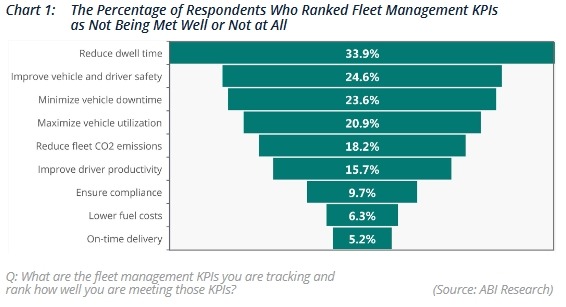
- Assess the fleet-based Key Performance Indicators (KPIs) that matter most to companies.
- Identify how fleet management solutions should and can help tackle challenges and
maximize fleet capabilities. - Discuss how mapping technology and location data solutions are helping fleet managers
overcome these challenges. - Help understand the key considerations to best implement fleet management s
Challenges Facing Fleet Managers Today
Maximizing Vehicle Usage And Available Assets
While the availability of truck drivers has declined, demand for truck transport has only continued to increase. These two opposing forces have widened the gap between an optimal level of fleet supply and transport demand, in turn creating a greater need to maximize available labor and vehicle capacity.
When a truck is stuck in traffic, delayed at a port or yard, parked due to lack of driver hours, or out of service and in need of maintenance, the impact on service levels and broader operations can be significant.
This article is posted at abiresearch.com

Please fill out the form to access the content